Why Edge AI Benefits from Small Rust Binaries
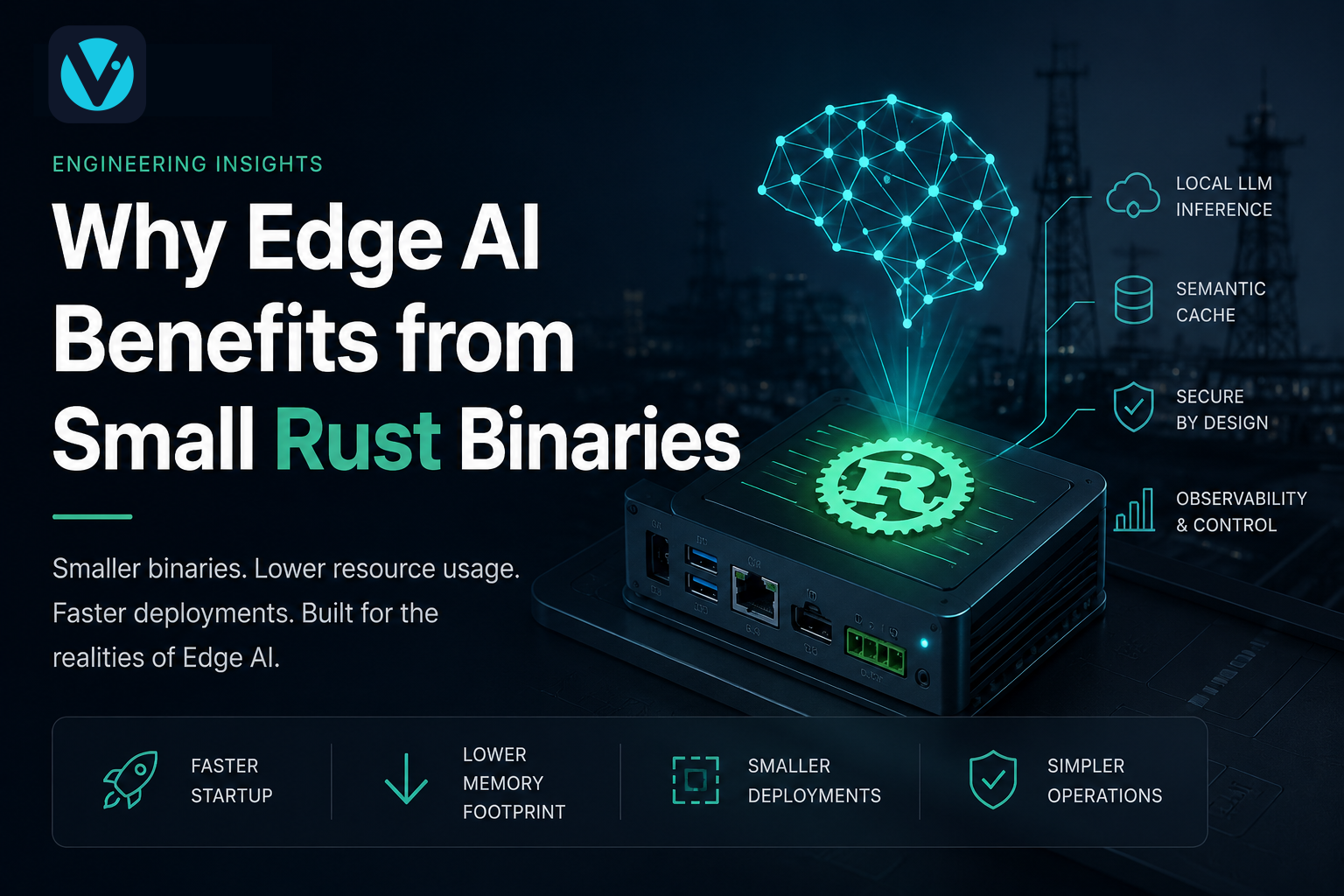
When people talk about Edge AI, the conversation usually revolves around models. Larger context windows, smaller quantized variants, GPU acceleration, inference speed, and hardware optimization tend to dominate the discussion. But in practice, many real-world Edge AI deployments are constrained not by the model itself, but by the operational realities surrounding it.
Running AI at the edge means running software in environments that are fundamentally different from modern cloud infrastructure. These systems may operate with limited memory, modest CPUs, unreliable connectivity, restricted storage, or strict uptime requirements. They may be installed in factories, telecom cabinets, or remote locations where updates are difficult and maintenance windows are limited.
In these environments, the infrastructure surrounding the AI model becomes critically important.
Inference alone is rarely enough. Real systems require routing, telemetry, caching, authentication, observability, synchronization, and APIs to name a few. As Edge AI deployments mature, the supporting software stack increasingly determines whether the system remains practical to operate over time.
This is where small Rust binaries become unexpectedly valuable.